Rationale


“We want our children to see the daylight and the sun go down on our land, the home of the Dreamtime, and to live there to their old age and really understand their culture.” David Mowaljarlai (1984)

2018 National NAIDOC Poster

The theme behind this unit of work is NAIDOC week. NAIDOC celebrations are held each year in July and provide a fantastic opportunity to involve students in celebrating “the history, culture and achievements of Aboriginal and Torres Strait Islander peoples” (NAIDOC, 2018).

Making such links enhances connections for children with their local community. NAIDOC provides a focus for the teaching and learning in the classroom and the techniques and pedagogy can be further implemented and encouraged as an ongoing priority.

The activities outlined in this unit are intended to be implemented into classroom practice during a school’s NAIDOC Week through open classroom opportunities, with parents and carers invited to share in the learning journey with the students.

cross-curriculum-priorities-aboriginal-and-torres-strait-islander-histories-and-cultures-overview-2bf28b58-a26e-40cd-825c-b12dfa83fd5a.png


Each activity in this unit of work links directly to the Australian Curriculum particularly focusing in where “Cross Curricular priorities” (ACARA, 2018) are signposted
The unit also draws upon the 8 ways framework (2012) which allows teachers to include and teach through Aboriginal perspectives using Aboriginal learning techniques.

8ways.png

The 8 ways “supports meaningful cross-cultural dialogue and shared learning experiences” (Haberlah, 2017). This culturally informed pedadgogy is informed by “ways of knowing, ways of doing, ways of being and ways of valuing” (Martin, 2017, as cited in Haberlah, 2017).

It is with this in mind that the four activities have been developed, to focus student’s learning of country, place, culture and people.

Firstly, in Activity 1, through an opportunity to learn about the importance of story-telling with a focus on Dreamtime.

In Activity 2, students will examine their own environment and the different ways in which places are represented.

Activity 3’s focus is expressing ideas through music.

Activity 4’s focus is on learning about identity through contemporary visual art and how relationships between people and place can be conveyed.

Helen Henaghan

Activity 1 – Warnayarra the Rainbow Snake

Grade: Kindergarten

Australian Curriculum links: Foundation > English > Literature

  • Recognise that texts are created by authors who tell stories and share experiences.
  • Recognising that there are storytellers in all cultures.
  • Viewing stories by Aboriginal and Torres Strait Islander storytellers.

Read and share the text, Warnayarra the Rainbow Snake, told by Senior boys from Lajamanu School, Northern Territory. Talk about the text and look at the pictures painted by the students to illustrate the story. Think about how the telling of these stories plays an important role in passing on Aboriginal Culture and Dreaming stories.

IMG_6483.jpg

Look at a selection of Aboriginal symbols and talk about how symbols can be as used as illustrations to tell and share a story. 7269538_orig.jpg

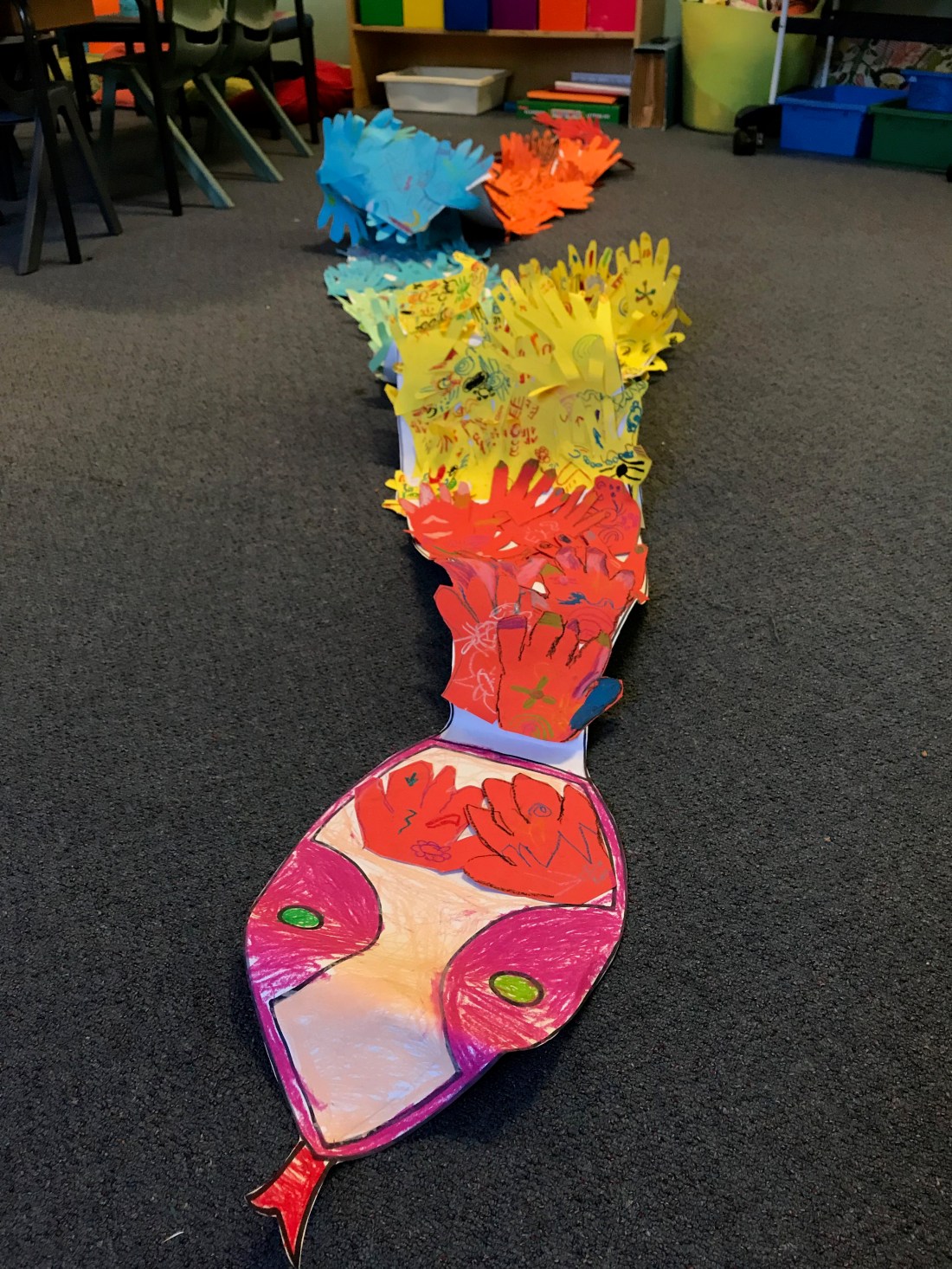
Draw around and cut out hand shapes on coloured card, adding symbols to tell our own stories.

Create and display a Kindergarten Rainbow Serpent by joining all of the story hands. The results of this activity can be displayed to create a feature for students and visitors. The snake in the photograph below was created during NAIDOC week 2018, with children and parents working together to create the hand prints.

IMG_6493.jpg


Activity 2 – Local Excursion, Aboriginal Carvings at the Coal Loader, Waverton

Grade: Kindergarten

Australian Curriculum links: Foundation > Humanities and Social Science > Geography:

  • The Aboriginal or Torres Strait Islander Country/Place on which the school is located and why Country/Place is important to Aboriginal and Torres Strait Islander Peoples
  • Identifying local Aboriginal and/or Torres Strait Islander landmarks in the local area

Whale 2_edited.jpg

IMG_6487.jpgIMG_6488.jpg

This activity uses the Coal Loader in Waverton, Sydney as an example of a local excursion that could be made to explore Aboriginal and/or Torres Strait Islander landmarks in the students local area. As educators it is important to make links with the local community to develop students understanding and make connections to local Aboriginal culture from the past and the present.

Plan a class/grade excursion to The Coal Loader, Waverton.

coalloader_walkingmap

Take photos and record ideas about the special place.

Draw a picture and write a sentence about the place.

IMG_0003.jpg

Link to word doc

Activity 3 – Music for the Dreaming

Grade: Kindergarten

Australian Curriculum links: Foundation > Music:

  • Respond to music and consider where and why people make music, starting with Australian music, including music of Aboriginal and Torres Strait Islander Peoples
  • Listen to and talk about music and musical instruments from different contexts and cultures.

music .png

Listen to Music for the Dreaming Chapter 1: Galaa

“Galaa means summer in the Dhurga language of the Yuin People, and in Wreck Bay, summer means fishing!

Listen for the sounds of summer like cicadas singing and happy bongo rhythms, do the Rompy Stompy Crab dance, sing-along to Aunty Brenda’s song, and learn Dhurga words associated with the season.” (ABC Kids Listen)

Talk about the music and respond to it. What does it make us think of, what do we hear?

Paint a response to the music. Give the students a selection of colours and talk about shapes, form and mood and allow students to paint their individual response as they listen. Use ink and straws to create art works such as these below.IMG_6497.jpgIMG_6498.jpg


Create summer music. Using a selection of simple percussion instruments, children can work with a partner or in a small group to compose a response to the music they have heard. Allow time for oral reflections of and discussion about their own and each others compositions.

Activity 4 – John Mawurndjul

Grade: Kindergarten

Australian Curriculum links: Foundation > Visual Art:

  • Respond to visual artworks and consider where and why people make visual artworks, starting with visual artworks from Australia, including visual artworks of Aboriginal and Torres Strait Islander Peoples
  • Consider viewpoints – societies and cultures: asking questions – Where is this artwork from and why was it made? Who made the artworks? Where and how are they displayed?
  • Identify how design elements, such as line, shape, colour to texture, are used in their artworks and in the artworks of others.

Share the work of John Mawurndjul from the MCA exhibition guide. Talk about where his artwork is from and where they are displayed. Find out about where John Mawurndjul lives and look at a map of Australia to locate Arnhem Land.

Watch the short video below which shows John creating his art work.

2015.2703_Edited.jpgthylacine_hTMIJiP.jpg18_Turtle_8I3B2056t.jpg
John’s work is often painted on eucalyptus tree bark. Talk to the children and make connections to what they already know about bark painting. Encourage discussion using talking partners.

(The guide also provides links to details of all of the animal paintings with audio pronunciations.)

Provide enlarged examples of the paintings.

IMG_0002.jpg

Talk about and focus on the shapes, patterns, colour, texture and form.

Use the templates below to explore ideas using similar shapes and colours.

IMG_0001.jpg


References

Aboriginal Symbols. (image). Retrieved from: https://lundgrenart.weebly.com/aboriginal-art.html

ABC Kids Listen. (2012). Classic Kids: Music for the Dreaming. Chapter 1. Australian Broadcasting Corporation and Education Services. Retrieved from: http://education.abc.net.au/home#!/digibook/ 2947053/classic-kids-music-for-the-dreaming

ACARA. (2018). Australian Curriculum. Retrieved from https://www.australiancurriculum.edu.au

8 Aboriginal Ways of Learning (2012) Retrieved from: http://www.painaustralia.org.au/static/uploads/files/8-aboriginal-ways-of-learning-factsheet2-wfklwmnralub.pdf

Haberlah, D. (2017) 8 Aboriginal Ways of Learning – a review. Retrieved from: http://haberlah.edublogs.org/2017/12/06/8-aboriginal-ways-of-learning/

Lofts, P. (1987). Warnayarra the Rainbow Snake. An Aboriginal Story. Scholastic Press. Gosford.

Mawurndjul, J. (2018) I am the old and the new. Museum of Contemporary Art Australia (MCA). Sydney

Mowaljarlai, D. (1984) When the Snake bites the Sun. An Aboriginal Story. Scholastic Press. Gosford.

NAIDOC. (2018). Because of her, we can! Australian Government. https://www.naidoc.org.au/get-involved/2018-theme

North Sydney Council. (2018). The Coal Loader Walking Map. Retrieved from: https://www.northsydney.nsw.gov.au/Waste_Environment/The_Coal_Loader/Visit_the_Coal_Loader

Whale Carving. (image). Retrieved from: https://www.atlasobscura.com/places/aboriginal-carving-whale